 En
En
 Français

STARCK EXHIBITION 1977 - 1988 CHAIRS
16 rue Guénégaud 75006 Paris / 9 April 2024 - 20 April 2024
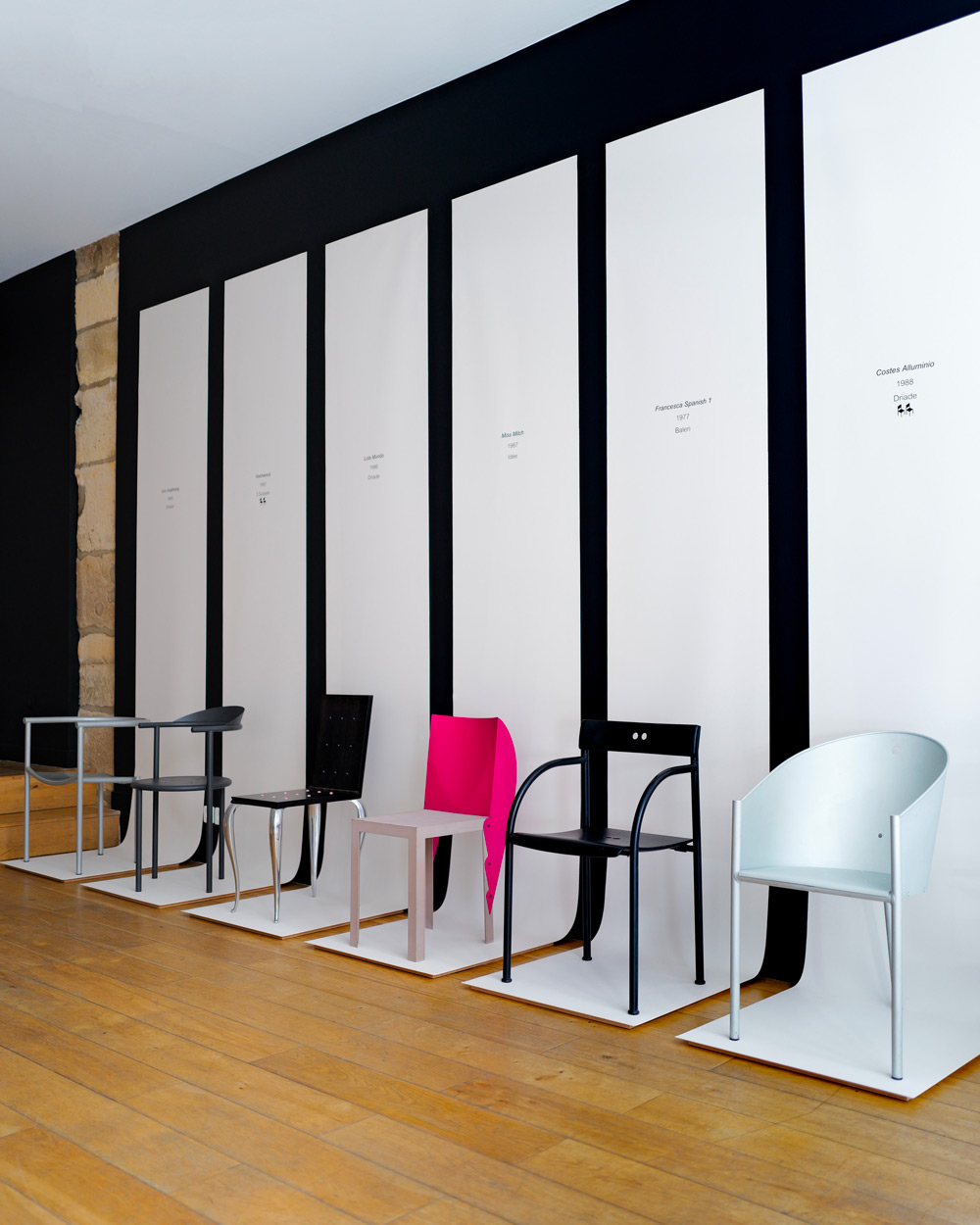
Starck: an intuitive designer despite theories
Although Starck describes himself as uneducated and ignorant of major theories, he is nonetheless in line with the continuity of different theoretical currents, although he rejects the labels. He believes in evolution, not revolution. Reluctant to theorise, he sometimes works outside intellectual frameworks, old or new, producing unclassifiable objects. Nonetheless, his work is guided by underlying principles that can be seen in the chairs on display, and which make it possible to read almost all of his work up to the end of the 1980s.
The chair: revealing the designer
The choice of the chair is not insignificant: Pierre Staudenmeyer, a gallery owner specialising in contemporary decorative arts, describes the chair as a profound expression not only of the artist, but also of himself. According to him, it is the most common and most perilous exercise for the artist, the most engaging and the most expressive. It is an obligatory step, where the creator is judged on form, function and meaning. Following in the footsteps of his father, an aircraft designer who saw design as a duty, Starck designed models that were close to his heart from an early age, often long before he was actually able to produce them around the 1980s.
A dense and seminal production (1977-1988)
Of the twenty or so chair designs produced by Starck between 1977 and 1988, eighteen are on display here, providing an insight into the principles underlying his work.
Some of the pieces on display were produced in response to specific commissions. One example is the project for La Villette ( 1984).
Modern furniture: lightness, folding and economy
At the start of this production, Starck was convinced that "modern furniture can only be light, foldable, dismantlable and discreet [...] it is obvious that tubulars are now one of the most modern and economical products, which can be manufactured without investment, and which therefore correspond perfectly to the general economic situation". This is illustrated by a large number of models grouped together here. The Miss Dorn (1982) is, in the designer's own words, an exercise in reduction. The Miss Wirt (1983), which can be dismantled, consists of a stretched fabric that reduces the chair to its minimum. Many models are stackable, such as the Starck Chair (1984), the Lila Hunter ( 1988) and the Romantica (1988). The Mickville (1983), the Lola Mundo (1986) and the Mrs Frick (1984) can be folded and so on.
It is perhaps the Francesca Spanish (1977), the result of several years of reflection, that best illustrates this vision of furniture characteristic of Starck's early work. With this model, the designer succeeded in producing a folding chair with an invisible system, a revolutionary yet extremely simple piece of furniture designed for small flats.
A clear link with functionalism
As Christine Colin points out, these creations and Starck's numerous appearances in the press provide clues that Starck is part of a certain continuity with functionalism. The designer uses terms such as "function", "use", "service plus", "logic" and "coherence". He states that "The object must be reduced to its minimum but exist as much as possible", and seeks to produce objects that fulfil several functions in order to save time, space and money. We might even see an extension of this notion when it takes into account available resources or the safety of manufacturers in relation to the materials used.
From function to form: towards an aesthetic of folding
But Philippe Starck is not limited by this functionalist heritage. In the course of his research into folding furniture, he moved from a rehabilitation of function to an aestheticisation. The folding system is no longer hidden, but becomes an integral component of the piece, as in the Mickville (1983). In some cases, the folding lends a graphic dimension to the object, which is self-sufficient when folded and transformed into a sculpture, as in the case of Mrs Frick (1984).
The object as symbol: the legacy of Memphis
With this work, Starck produces pieces in which the notion of function is not limited solely to the dimension of use or technological determinism. On the contrary, Starck broadens this notion to include what might be called 'symbolic' functions. Although these can often only be measured by irrational parameters, they are of vital importance: an object is as much determined symbolically as technologically or ergonomically. Starck has taken on board the teachings of the Memphis group. This group was able to formulate and concretise a new, broader, expansive understanding of the concept of function, basing it on a set of more symbolic, irrational and emotional values.
Breaking down the opposition that might exist between these two functions, utilitarian and symbolic, Starck created the Lola Mundo (1986), with which he sought to demonstrate that it is possible to mix different ways of thinking by proposing a chair that is both baroque and functional. "Why shouldn't the baroque also be functional? Why shouldn't the functional also be baroque?
Starck puts these new functions at the heart of his work, seeking to symbolise situations, or sometimes to tell a story, hence the names of the models taken from the book Ubik, or his diversion of elements taken from other universes. We might mention his affection for the curtain, with its theatrical aspect, or the Miss Wirt canvas, which goes from being a minimal object to a backdrop.
Irony, colour and social criticism
Starck also dreams of creating an emotional bond between himself and the user, as illustrated by his three-legged chairs. According to him, such a chair "demands more attention, more participation, more intellectual and sensual demands from the user. There is a relationship with the person who is going to sit down. "Swinging on a tripod is more dangerous, but more fun. Here Starck introduces an ironic dimension that is considered to be the essential characteristic of postmodernism. More generally, Starck wanted to give interpretation and the public a role. He wants objects to become a social and cultural flag that people can recognise.
According to Starck, it is possible to criticise or reflect a society through a piece of furniture. This is what he does with his choice of colours. In the early 1980s, he saw France as a country without hope, a judgement he expressed decoratively through the use of grey, which he saw as an energy absorber, a symbol of nothing, non-choice but good taste. The country's economic problems also prompted him to produce black furniture. "Black is the ultimate. You can only start again afterwards. After that, France is on the move. I launched my silver and aluminium ranges, symbols of speed and modernity", like the Romantica (1988) and the Costes Alluminio (1988).
Later, the situation improved, according to him, particularly in cultural circles. "I colour my silver very lightly, tinting it blue, pink or green". These were the colours used for Lila Hunter (1988) and Miss Milch (1987).
New horizons: towards all-wood production
Philippe Starck then broadened his approach, producing an all-wood collection in 1989. Unlike the period covered in this exhibition, this production has never been analysed.