 En
En
 Français

DUST EXHIBITION: THE M.D.F. AND THE DESIGNERS OF THE 80S
16 rue Guénégaud 75006 Paris / 26 November 2024 - 7 December 2024
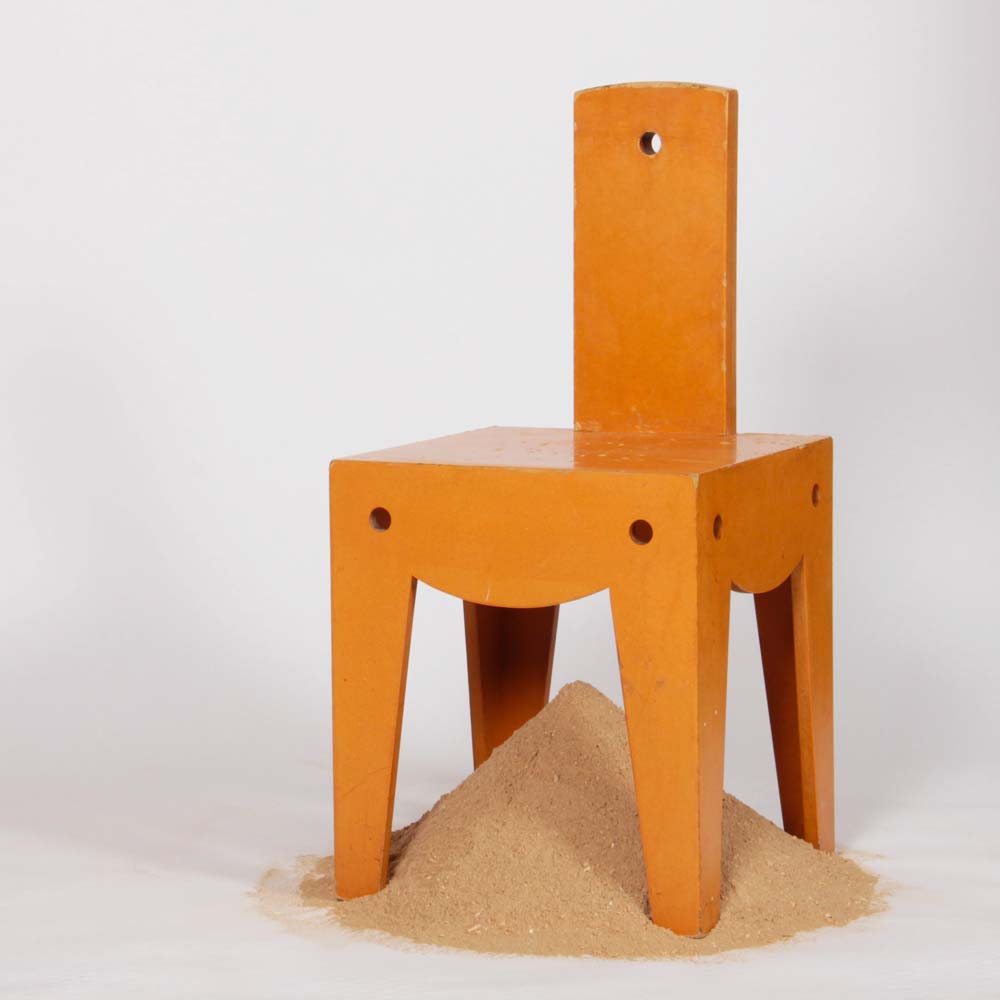
The birth of a new material: MDF
The DUST exhibition brings together a range of pieces made partly or entirely from dust. The dust is original because it comes from wood, and has been transformed to create M.D.F..
This artificial wood was created in the 1960s when American researchers developed Medium Density Fiberboard (MDF). Obtained by treating wood fibres, this material is intended to replace wood in a wide range of applications.
Artificial wood with unique properties
The product that comes out of the factory is a light brown colour, with smooth sides, distinguishable fibres and small spots of glue. Halfway between wood and paper, it combines traditional appearances with the reality of a new substance. Similar to wood in its technical and mechanical characteristics, MDF can be grooved, drilled, assembled, turned, cut, moulded, bored or sculpted. On the other hand, it has no grain direction, does not splinter or warp and its fine, even surface makes it an excellent base for all finishes, veneers, laminates, paints, lacquers or PVC films. These technical and aesthetic qualities make it the most accomplished generation of artificial wood. In particular, because it is not constrained by the direction of the fibres, it is easy to cut and has more remarkable characteristics than other fibreboards.
The arrival of MDF in Europe and its first uses
MDF arrived in Europe in 1970. Thanks to its fineness and regularity, it was initially used as a substrate for veneers, laminates and lacquers. In the early 1980s, Pierre Sala made a series of lacquered chairs, two of which are shown here.
The 1980s: from humble material to luxury material
From the mid-1980s onwards, MDF became more than just a support. Like others before it, this material, originally seen as poor, came to the fore. Through the uses they make of it, designers take it out of its initial condition and elevate it to the status of a luxury material.
This treatment of MDF was recognised in 1988 with an exhibition of the same name at the Fondation Cartier, then still in Jouy en Josas. The exhibition highlighted the designers' research and experimental work. As evidence of this interest, a year earlier François Bauchet had chosen MDF for some of the furniture in the foundation's offices, in particular the tables, one of which is shown here. The exhibition also featured work by a number of other designers, including the duo Fabienne Arietti and Thierry Husson, Gérard Dalmon, Christian Duc, René-Jean Caillette, Elizabeth de Portzamparc, Olivier Gagnère and Martin Szekely.
M.D.F. as a field of experimentation for designers
Numerous designers are seizing on this new material, each finding a different interest in it and interpreting it in their own way.
Elizabeth de Portzamparc recalls the technical possibilities offered by MDF in her 24-hour desk designed using a moulding process: "It gives wings to the imagination! It allows us to work on the borderline between sculpture and functional objects. It's everything I love. Beyond its technical possibilities, it's the look and the 'humble' connotation of MDF that appeal to a whole range of designers.
Techniques, aesthetics and the ennoblement of the material
For Martin Szekely, material and colour are merely anecdotal, a product of technical and aesthetic constraints, and he gets round the apparent poverty of the material by using sophisticated finishes: several layers of coloured varnish, in the style of the finest contemporary cabinet-making. The material effects and value nuances of the raw material, accentuated by the varnish, reveal the surfaces: "I'm looking to achieve something visually powerful".
Synthetic wood gives Christian Duc a new opportunity to embark on an exercise in ennobling so-called 'industrial' materials: "It's been used as a lacquer base since the 1960s. I wanted to discover its true beauty. I have the same interest in granite, the poor materials of the 40s. By associating it with so-called 'noble' materials such as metal, he dispels the prejudices that usually hang over particleboard. A similar approach is being explored by Elizabeth de Portzamparc.
Wide distribution: from design to industry
The use of MDF is not limited to the designers exhibiting at the Fondation Cartier. Starck also made use of it, for editions such as the Ray Noble bookcase distributed by Habitat, or for the table tops furnishing the interior of the famous Costes café.
Alongside the designers, other players in the production process also got involved. Cabinet-makers, of course, some of whom specialised in working with MDF, but also, and above all, publishers: Neotu for Martin Szekely, Bauchet and Dalmon, Le Via for René-Jean Caillette's chair, CMB for Christian Duc's chest of drawers, Tracé Intérieur for Portzamparc's desk, Ecart International for Olivier Gagnère, and Husson and Arietti, who had their own publishing house called AH. In this way, artificial wood is becoming institutionalised.
The legacy and future of a revolutionary material
A revolutionary material, MDF has been a source of many opportunities for designers who have incorporated it into their worlds. It has been used in a wide range of productions, from special orders to mass production. Although it was in the spotlight for a decade and is still used today, MDF is no longer the focus of experimentation, which is now turning to new materials or even updated versions of old materials. Its increased use during the 1980s is nevertheless a testament to its flexibility and versatility, having opened up a playground for a generation of designers.